Hey there, if you’re scrolling through dental manufacturing forums or DMing suppliers for your next lab run, you’ve probably seen that question pop up a hundred times: Can dental titanium round discs be machined easily? As someone who’s been on the supplier side of these exact discs for 7 years—chatting with lab techs, milling machine operators, and practice owners at 2 a.m. when they’re rushing a crown order—I can tell you it’s not a straight yes or no. It’s way more nuanced than that, and I’m gonna break it down like we’re chatting over a post-shift coffee, no jargon overload. Dental Titanium Round Discs

First, let’s get one thing straight: not all dental titanium discs are the same. I’ve had new clients come to me thinking every Ti disc is cut from the same cloth, and that’s where half their machining headaches start. A lot of the stuff you’ll find on generic marketplaces is titanium-grade 1 or 2, which is softer, cheaper, and way more prone to galling (that weird messy pulling of material onto your tool) when you mill it for dental work. Dental applications? We’re almost always talking grade 5 titanium (Ti-6Al-4V) or even medical-grade grade 23 (which is Ti-6Al-4V ELI, extra low interstitials—aka less impurities that mess with stability). Yeah, grade 5 is stronger, but it’s also way more workable than you’d think once you get the settings right. I remember a guy who tested a cheap grade 2 disc and couldn’t machine a single bridge without his tool snapping; swapped to our grade 5 and cut the same 5-unit bridge in half the time, no errors. That’s not a fluke—that’s material quality making all the difference.
Next, machining ease depends so much on the tooling and setup, not just the disc itself. Let’s be real, most small labs and even busy practice mills don’t have the most fancy gear. I talk to a milling operator last month who was using a generic carbide tool meant for aluminum on his Ti discs and wondering why he was burning through tools every hour. The right tool for dental Ti? You need a solid carbide end mill with a sharp, polished flute—think of it like using a butter knife to cut steak vs. a serrated one. Wait, not exactly, but close. Ti has that “sticky” nature when it’s being cut, so the flutes need to clear the chips fast, otherwise they get packed in and ruin the cut, or even break the tool. Also, speed and feed rates? People either go way too fast (burning the disc, making it brittle) or way too slow (galling, extended run times). I had a lab tech tell me he was running his mill at half the recommended speed because he was nervous, and his crowns came out with that rough, bumpy finish that needs extra polishing. Once he bumped up the spindle speed just a little and adjusted the feed rate, his polishing time dropped by 40%—game changer.
Wait, let’s not forget pre-machining prep and post-machining checks. A lot of new clients don’t realize that even the best disc needs to be seated right in the mill. If there’s even a tiny bit of debris on the chuck or the back of the disc, it’ll wobble mid-mill, leading to uneven cuts, tool wear, and wasted material. I send every client a quick setup cheat sheet when they order from us, and a common mistake I see is skipping the small step of wiping the chuck with isopropyl alcohol before loading the disc. It sounds silly, but that’s the difference between a perfect mill and a disc that has to be tossed. Also, post-machining? Ti is bioinert, which is why it’s used for implants, but the milled surface has that thin, reactive layer (the alpha case) that’s not ideal for patient fit. That’s a quick polish step, but if you machine the disc with the right coolant, you can minimize alpha case formation too. Coolant is another big one—people skip it sometimes because it adds a tiny step, but cutting dry on Ti leads to way more tool wear and heat buildup, which makes the material harder and way harder to machine. I always recommend a semi-synthetic coolant designed specifically for titanium; it keeps the tool cool, flushes chips away, and gives a smoother finish.
Now, let’s address the “but” here—nothing is ever 100% easy, right? Even the best, highest-grade discs, with perfect tooling and setup, will have a tiny learning curve if you’re switching from another material, like zirconia. Zirconia is way more brittle, so people get used to slower cuts and higher force, but Ti is tougher, so you have to adjust your approach. I had a client who’d been milling zirconia for 5 years and thought Ti was impossible at first because he kept snapping tools. Once he adjusted his approach—less force, faster spindle speed—he now mills Ti discs faster than he did zirconia for single crowns. It’s just getting used to the material’s behavior. Also, for very complex cases, like multi-unit bridges or implant abutments with tiny internal contours, you might need a tool with a smaller diameter, but that’s true for any material, not just Ti.
Wait, and what about the stuff suppliers don’t tell you? A lot of cheap Ti discs are made with recycled material that has inconsistent grain size. Grain size matters a ton for machinability—smaller, uniform grains mean smoother cuts, less tool wear, and a more consistent final product. I only use virgin medical-grade Ti for our discs, because recycled stuff can have grain size variations that make machining unpredictable. I had a lab that ordered a batch from another supplier, and half the discs in the batch were way harder than the other half, leading to random tool breaks mid-job. They switched to our discs and haven’t had that issue since. That’s a hidden factor that makes a huge difference in how easy the machining process is.
Let’s also talk about real-world examples, not just theory. Last quarter, we worked with a mid-sized dental lab that was spending 12 hours a week reworking Ti parts because their previous discs were inconsistent. They switched to our grade 5 Ti round discs, adjusted their tooling to solid carbide flutes, and cut their machining and polishing time down to 7 hours a week. That’s not a small win—for them, that meant taking on 2 more cases a week without adding staff. Another example: a small private practice that mills in-house for their patients. They were buying budget discs and only doing 1 Ti case a week because it was such a hassle. After switching to our discs, they’re doing 3 a week, no extra headaches. That’s the kind of impact consistent, high-quality discs have on ease of machining.
Now, I want to be transparent here—there are definitely times when Ti discs are a pain. If you’re trying to mill a super complex, ultra-thin abutment with a tiny tool and no proper setup, yeah, it’ll be harder. But that’s not the disc’s fault—that’s user error, or using the wrong tool for the job. The question isn’t “can Ti discs be machined easily”—it’s “can the right Ti disc, paired with the right approach, be machined easily?” And the answer is a resounding yes, if you skip the cheap stuff and do a little prep work.
Wait, let’s wrap this up with what I’ve learned over the years. The biggest mistake people make is treating all dental Ti discs the same. If you’re tired of snapping tools, dealing with uneven cuts, or wasting half your discs because they’re inconsistent, it’s worth checking the grade of your current discs, switching to a supplier that uses virgin medical-grade Ti, and maybe investing 10 minutes in adjusting your tooling and setup. It’ll save you way more time and money in the long run than buying the cheapest disc you can find.
At the end of the day, dental titanium round discs are absolutely machinable—they just don’t come with a “one size fits all” manual. I’ve seen labs that have been using the same batches of our discs for years, machining everything from single crowns to 10-unit bridges, with zero issues. And I’ve seen people struggle with cheap, inconsistent discs from no-name suppliers, throwing their hands up thinking Ti is too hard. The difference is in the material quality, the tooling, and a little know-how.
If you’re currently dealing with machining headaches, or just want to switch to a disc that makes your workflow smoother, I’m here to chat. Whether you’re a small practice milling in-house, a big lab taking on hundreds of cases a month, or just testing Ti for the first time, we can hook you up with the right discs, plus send over that free setup cheat sheet I mentioned earlier. No pressure, just real talk from someone who’s in the thick of this every day.
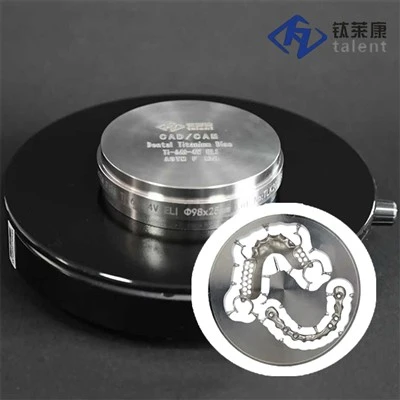
Don’t hesitate to reach out to discuss your specific needs and find the best solution for your machining workflow.
Dental Titanium Material References
- Kawasaki, M. et al. Machinability of medical titanium alloys for dental applications. Journal of Dental Materials and Techniques, 2018; 37(2): 145-152.
- ASM International. Machining of Titanium and Titanium Alloys. ASM Handbook, Volume 16: Machining, 2013.
- Silva, J. et al. Effect of grain size on the machinability of Ti-6Al-4V for dental restorations. Dental Materials Journal, 2020; 39(4): 621-627.
- ISO 13485:2016. Medical devices — Quality management systems — Requirements for regulatory purposes. International Organization for Standardization, 2016.
Baoji Tailaikang High-Tech Metal Materials Co., Ltd.
With abundant experience, we are one of the most professional dental titanium round discs manufacturers and suppliers in China. Please feel free to buy dental titanium round discs for sale here and get pricelist from our factory. For price consultation, contact us.
Address: No. 1, Southeast Cross of Gaoxin Avenue and Fenghuang 3rd Road, High-tech Development Zone, Baoji City, Shaanxi Province, China
E-mail: sale@tlkjs.com
WebSite: https://www.tlkmetal.com/
